ServicesPool Drain and Refill
Pool Drain and Refill in Phoenix
When your chemicals stop doing their job, the water itself may be worn out. We test for dissolved solids, calcium and stabilizer before recommending a drain, then empty, inspect and refill your pool with care for the surface and the equipment.
Fresh water, but only when the water is truly spent
Every pool slowly collects what evaporation leaves behind. Water leaves, minerals stay, and each top-off adds more. Over time the total dissolved solids, calcium hardness and cyanuric acid climb until chlorine struggles to work and scale builds on the tile. At that point no amount of added chemicals will fix it. The only real cure is replacing the water.
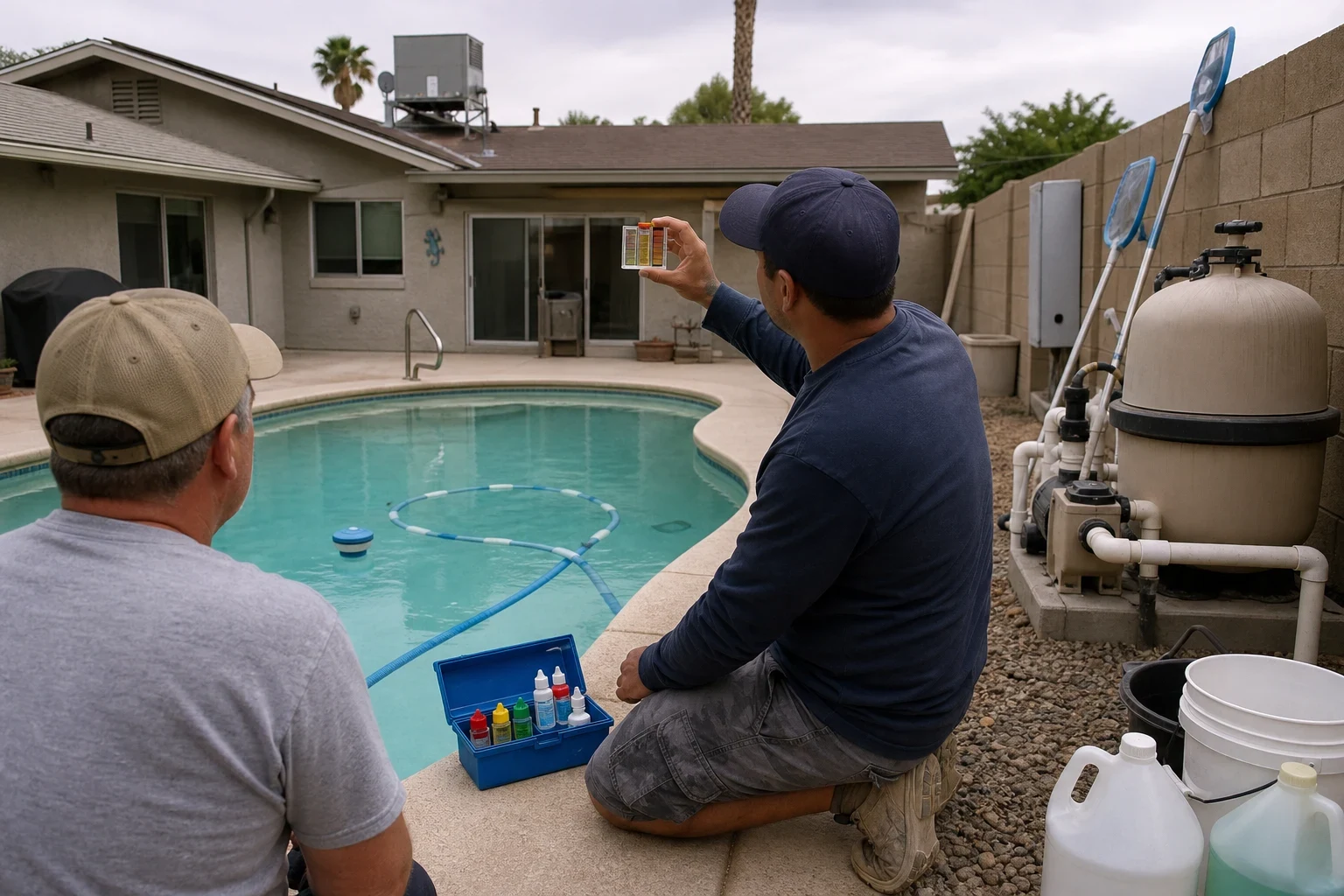
We do not assume that is your situation. A drain and refill is a big step, so we start with a full water test and look at your filter and circulation. Sometimes cloudy water is a dirty filter, and Filter Cleaning solves it for far less. When the numbers do point to a drain, we tell you why and show you the readings.
We are CPO certified, and that training shapes how we handle the fresh fill: balancing it carefully so the new water protects your plaster or pebble finish instead of etching or scaling it.
What a drain and refill with us includes
Water testing before we quote
We read total dissolved solids, calcium hardness, cyanuric acid, pH and alkalinity. You see the numbers and our recommendation, including whether a partial drain would be enough.
Controlled draining
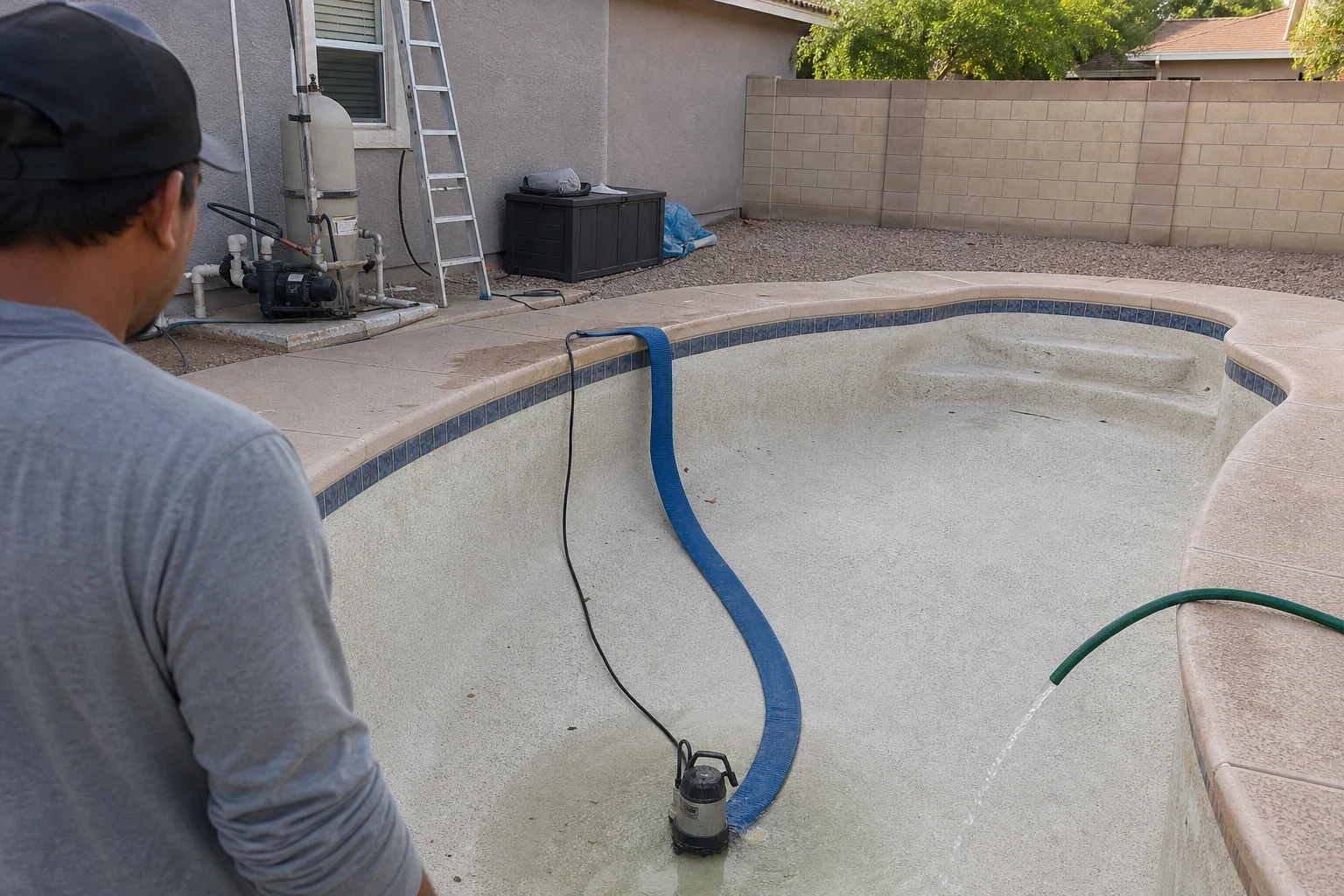
A pump sits in the deep end and the outflow goes where local rules allow, which in most cases is your sewer cleanout and not the street. We stay with it so the pump never runs without water.
Hydrostatic valve and equipment check
Before the last of the water is gone we check the main drain and the hydrostatic relief valve, then shut down and protect the pump and heater. Being ROC licensed, we can tell you directly if anything below the waterline needs repair while it is within reach.
Inspection of the empty shell
Draining reveals what water conceals: cracks, delamination, loose tile and worn finish. We take photos of anything that deserves your attention and walk you through what it means.
Surface cleaning
We remove debris and rinse down the walls and floor. If scale or staining needs more than a rinse, an acid wash or calcium removal and tile cleaning can be done on the same visit.
Continuous refill and start-up balance
The pool fills in one unbroken run so no ring line sets into the finish. Then we balance the new water and bring your equipment back online.
Signs your pool water may need replacing
- High dissolved solids
- Once TDS climbs well past what comes out of your tap, chemicals stop pulling their weight and the water can look flat or feel heavy.
- Chlorine that never holds
- Stabilized tablets leave cyanuric acid behind. Past a certain level it ties up chlorine, so you keep adding more and algae still appears.
- White crust at the waterline
- Hard water leaves scale on the tile and rough spots on the finish. Scrubbing helps for a while, but high calcium keeps putting it back.
- Haze that outlasts a filter cleaning
- When the filter has just been serviced and the basic chemistry reads fine, yet the pool still looks milky, the water itself is usually worn out.
- Work planned below the waterline
- Resurfacing, tile work or main drain repairs all require an empty pool, which makes it a sensible time to start over with fresh water.
How the job runs
- 1
Test and confirm
We test your water, check the filter and decide together whether a full drain, partial drain or something simpler is right.
- 2
Prepare and drain
We protect your equipment, set the pump and drain to the approved discharge point. We pick a cooler time of year when we can, since strong summer sun is hard on an exposed finish.
- 3
Inspect and clean
With the shell empty, we inspect, photograph and clean. Any added work, such as an acid wash, happens now and only with your approval.
- 4
Refill and balance
We refill in one continuous run, restart circulation and bring the chemistry into range for your surface type. Then we leave you clear notes on the first week of care.
What shapes the price
We quote each drain and refill after we have tested the water and looked at the pool. The number depends on how big the job is and what the empty shell turns out to need. You get the quote in plain terms, by phone or on site, so the scope is settled before any water leaves the pool.
- Pool volume
- More gallons mean longer pumping in both directions and a larger dose of start-up chemicals to balance the new water.
- Full or partial drain
- When the readings show that replacing part of the water will bring things back into range, the job shrinks accordingly.
- Extra finish work while it is empty
- Adding an acid wash or calcium removal and tile cleaning means more labor on the day. It also spares you a second drain later, since the shell is already open.
- Discharge setup
- How far the hose has to travel to your sewer cleanout, and how it routes around your home, changes the setup time.
- Fill water
- The refill runs through your own water service, so that cost shows up on your utility bill and not on our quote.
Drain and refill questions
- How often does a Phoenix pool need draining?
- Every few years is common, because heat and evaporation concentrate minerals quickly. The calendar matters less than your test results. We recommend a drain when the readings call for it, not on a fixed schedule.
- Can you drain my pool in the summer?
- It can be done, but we prefer cooler months. An empty pool in intense sun puts stress on plaster and can cause problems with the finish. If summer timing is unavoidable, we keep the shell empty for as short a time as possible.
- Could my pool lift out of the ground when it is empty?
- It is uncommon, but groundwater pressure can push on an empty shell. That is why we check the hydrostatic relief valve before draining and keep the pool empty only as long as the work requires.
- Where does the drained water go?
- We follow local discharge rules, which usually means pumping into the sewer cleanout at your home. We do not run it into the street or onto a neighbor's property.
- Is a partial drain ever enough?
- Yes. If your numbers are only moderately high, replacing part of the water can bring them back into range. We will tell you if that is the better option.
Find out if your water really needs replacing
We will test first and give you a straight answer. Reach us by phone for a free quote on draining, refilling or a simpler fix.